Showing posts with label Thea Haines. Show all posts

Wednesday, 4 September 2013

Abundance!


Summer is a busy time for bees, and it's always a busy season for us Bees, too.  I always start the season with an ambitious list of things to accomplish, and in the end, have to concede I can only do about 1/4 of what I planned.

A good part of my summers are always spent trying to capture the fruitfulness of summer, hoping to keep up with the fruits and vegetables as they ripen in the garden and appear at the farmers' markets. Last year while I was away in London, I didn't do any gardening or canning, and I really missed it!  I made up for it perhaps too much this year, having made ten different kinds of jam, frozen and canned tonnes of fruit, and put by so many pickles, that my freezer is full and my store of empty jars is very depleted, and the season not finished yet.  I hope my near and dear ones look forward to holiday gifts of jam, relish and pickles, because I can't possibly consume it all alone!

I planted my own cucumbers this year because I love French cornichons, and wanted to try my hand at making my own.  This entailed picking tiny cucumbers (about 5 cm long) every other day, and storing them in the refrigerator crisper until there were enough to make one jar. I used fresh tarragon from my herb garden in these pickles, as well as in the pickled radishes I made.  Just trying to keep up with the cucumber plants, I made a ton of dills, piccalilli, and mustard pickle relish, just because I didn't want any to go to waste.  In the end I had to stop picking them because there is no way one lady can eat that many cucumber sandwiches!


By late August, the whole vegetable garden, including my patio herb garden, is totally out of control, and I feel a little overwhelmed! I prune the herbs and hang them to dry for later use in cooking, infusions and herbal tea.

 
To keep up with the tomatoes, I've resorted to not only canning, but also oven-drying or freezing all those I can't eat.  Oven-drying couldn't be easier.  Simply halve small tomatoes, such as plum, paste or cherry tomatoes, or slice larger tomatoes, such beefsteaks or heirlooms.  Place in a bowl,  drizzle lightly with oil and toss to coat. Spread in a single layer skin-side down over parchment lined baking sheets.  Sprinkle with salt and pepper, and any herb you desire (thyme, rosemary or basil are my favourites).  Place in a preheated 275 F oven, and leave for 1 1/2 to 6 (yes, six) hours, depending on the size and juiciness of the tomato, and desired dryness.  I like to leave them semi-plump (about 3 hours).  You can pack them in oil, but I prefer to freeze them on a tray and then place them, once frozen, into a freezer bag, to use in sauces and as pizza toppings in the winter for a taste of summer.


Wednesday, 4 April 2012

Historical Interpretation


Today, a sneak preview of one of the activities lately occupying much of my time.  Last year I was asked to be a part of an exhibition this spring at Harbourfront Centre on the occasion of the bicentennial of the War of 1812.  The premise of the exhibition fits perfectly with the current vein of my work as I've been recently exploring through the lens of natural dyes how our deeper past can shape the future.  I've always been fascinated by my own family's history, which is rooted in its immigration to Canada between 200 and 400 years ago.  The War of 1812 in particular is an important part in that story, as several of my ancestors can trace their settlement in southern Ontario to the period following the war.


I've been pondering the blurred lines between historical fact and fiction, how in the present we interpret the past, romanticize and embellish it; it is these narratives that bring the past alive.  With that in mind I decided to construct a costume for an especially legendary figure of the War of 1812, Laura Secord. The pieces I've been working on are based on garment patterns intended for historical interpretation and reenactment from Sense & Sensibility patterns.  In the process of sewing every stitch by hand of these regency era garments, I've learned just how laborious clothes-making was before the sewing machine.  No wonder clothing had so much more value historically.  I realised also that while the regency period was a period of relative freedom in women's dress, women still had to contend with layers of petticoats and undergarments that restricted their activities.


I've spent much time constructing undergarments, and now I've moved on to the outerwear, a dress and red coat. The piece above, the dress, has been printed with iron paste in imagery of plants of the roadsides of southern Ontario - purple loosestrife, goldenrod and Queen Anne's Lace. The rust colour will change once I've dyed the dress in a bath of oak gall, to the colour you see below.


1812-2012:  A Contemporary Perspective opens Friday April 20th, with a public reception beginning at 6 pm, at Harbourfront Centre, 235 Queen's Quay West, Toronto. 

Tuesday, 7 February 2012

A Bee Abroad


In October, I temporarily left the hive to move to London, England, while I study for my master's degree in textiles at Chelsea College of Art & Design. I chose Chelsea because its Textile program has a focus on sustainability, which is becoming an increasingly important aspect of my work, and outlook on life. Chelsea has an unique research centre, TED (Textiles Environment Design) which is part of a larger partnership with Central Saint Martin's called the Textile Futures Research Centre. For anyone interested in textiles in general and sustainability specifically, explore both their websites for volumes of fascinating research and inspiring projects.


My MA project focuses on natural dye printing, something with which I've long wanted to experiment. So much of my own work and teaching involves screenprinting, and as much as I love the beautiful effect of printing with conventional fibre-reactive or acid dyes, I worry about the long term health and environmental effects of all the chemicals involved in the process. I've had a lot of experience using natural dyes for immersion dyeing, some of which we've shared with you here on the Beehive, but little experience with using natural dyes for printing. I had a sense of how they might work for printing, but I'd never really tried to use them.

I thought the perfect way to begin would be to take a workshop at the Maiwa Symposium in Vancouver, which is also something I've always longed to do but could never fit in, as the symposium falls during the fall school term. The workshop at Maiwa gave me the confidence to get going!


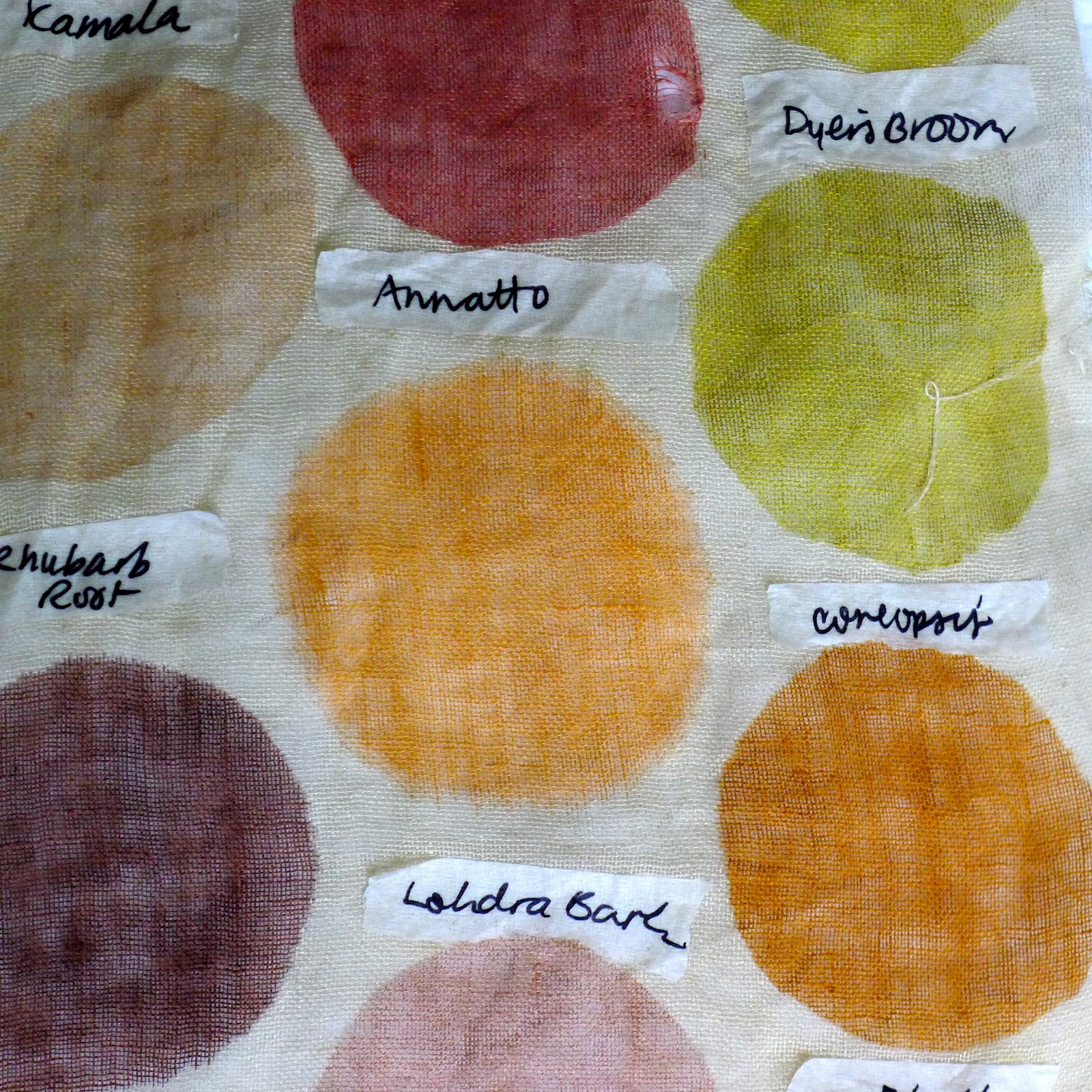
Since arriving in London and settling into the studio at Chelsea, I've been experimenting with the colours I can produce using the various natural dye extracts available from different sources. Maiwa, Couleurs des Plantes, Couleur Garance, Earthues and Pure Tinctoria all sell a variety of ready-to-use natural dye extracts from ethical and sustainable sources. The extracts are relatively easy to use as they dissolve in water, but you can also make your own extracts from dried or fresh dyestuffs.

I thicken the extracts with a gum to produce a paste appropriate for screen printing. So far, as I'm only in the early stages of testing, I'm stencilling the print pastes onto mordanted cloth rather than screen printing, which will come later. The colour testing will also involve pushing the range of hues by shifting colours by adding acid, alkaline or other mordants to the colour after it has been applied. What you see here are some of my early samples in progress, which give you an idea of the range of colour you can achieve using all natural colourants, all derived from plant and a few insect sources.


A large part of my investigation is researching the plants that produce dyes, and their chemical, cultural and economic histories. I've been making ink and crayon drawings of these plants from historical herbaria (scrapbooks of preserved dried plant specimens) to develop imagery which I will later use in screen printed patterns.

When I return home, I hope to share my newly gained knowledge with anyone wanting to learn more about these precious and wonderful sources of colour. Read more about my project over the next 6 months as it progresses on my blog, now up and running again after months and months of neglect!

Wednesday, 18 May 2011

Surfacing


This past weekend marked a highly anticipated event in the Beehive calendar. It was the opening of Surfacing: contemporary textile and craft objects at James Buttrum & Son gallery on James Street North. Comprised of the work from eleven graduating students of Sheridan College's Textile program, this show aimed to illustrate and encourage discussion on the topic of contemporary crafting; specifically in regards to textiles and fibres.
 
I had some downtime during my own art crawl preparations at White Elephant (which never happens) and I knew I wouldn't get the chance to check the show out later in the evening, so I stopped by Friday afternoon, camera in tow. As each of these artists studied under one of our very own Bees at Sheridan - Thea Haines - I knew that this show would not disappoint. 

Sabrina Parrish
Katherine Cordero
Katie Walker
Keiley Stewart
Left: Rachel Morrison   Right: Melodie Flook
Barbara Romanovsky
The students demonstrated a wide and impressive range of skills from hand-stitching to quilting to paper-making to machine embroidery thread drawing and natural dyeing. Keiley Stewart's wet and needle felted animal heads provided an interactive and amusing element to the show. Her partner, Owen, was nice enough to take an instant photo of Jane, my sister Nicole and myself, and he would continue to do so all night of patrons trying on the heads, as a part of the piece. It's funny because afterward we all discussed how all three of us each had huge grins on our faces as the camera snapped, realizing after that our faces were totally obscured.

Being a part of a craft collective, I may be biased in thinking that this was one of the best shows I have seen in recent history as a part of the art crawl. I think that a lot of times people equate crafting or fibre art with folk art (which is not necessarily a bad thing) and Surfacing served to redefine that view, exemplifying that textiles can be exquisite and delicate and detailed and fantastic and fun all at the same time.  Beautiful work, beautiful show. I can't wait to keep an eye on each of the artists involved in the show as they continue to grow and fine-tune their respective crafts.