Showing posts with label Textiles. Show all posts
Wednesday, 4 April 2012
Historical Interpretation
Today, a sneak preview of one of the activities lately occupying much of my time. Last year I was asked to be a part of an exhibition this spring at Harbourfront Centre on the occasion of the bicentennial of the War of 1812. The premise of the exhibition fits perfectly with the current vein of my work as I've been recently exploring through the lens of natural dyes how our deeper past can shape the future. I've always been fascinated by my own family's history, which is rooted in its immigration to Canada between 200 and 400 years ago. The War of 1812 in particular is an important part in that story, as several of my ancestors can trace their settlement in southern Ontario to the period following the war.
I've been pondering the blurred lines between historical fact and fiction, how in the present we interpret the past, romanticize and embellish it; it is these narratives that bring the past alive. With that in mind I decided to construct a costume for an especially legendary figure of the War of 1812, Laura Secord. The pieces I've been working on are based on garment patterns intended for historical interpretation and reenactment from Sense & Sensibility patterns. In the process of sewing every stitch by hand of these regency era garments, I've learned just how laborious clothes-making was before the sewing machine. No wonder clothing had so much more value historically. I realised also that while the regency period was a period of relative freedom in women's dress, women still had to contend with layers of petticoats and undergarments that restricted their activities.
I've spent much time constructing undergarments, and now I've moved on to the outerwear, a dress and red coat. The piece above, the dress, has been printed with iron paste in imagery of plants of the roadsides of southern Ontario - purple loosestrife, goldenrod and Queen Anne's Lace. The rust colour will change once I've dyed the dress in a bath of oak gall, to the colour you see below.
1812-2012: A Contemporary Perspective opens Friday April 20th, with a public reception beginning at 6 pm, at Harbourfront Centre, 235 Queen's Quay West, Toronto.
Tuesday, 7 February 2012
A Bee Abroad
In October, I temporarily left the hive to move to London, England, while I study for my master's degree in textiles at Chelsea College of Art & Design. I chose Chelsea because its Textile program has a focus on sustainability, which is becoming an increasingly important aspect of my work, and outlook on life. Chelsea has an unique research centre, TED (Textiles Environment Design) which is part of a larger partnership with Central Saint Martin's called the Textile Futures Research Centre. For anyone interested in textiles in general and sustainability specifically, explore both their websites for volumes of fascinating research and inspiring projects.
My MA project focuses on natural dye printing, something with which I've long wanted to experiment. So much of my own work and teaching involves screenprinting, and as much as I love the beautiful effect of printing with conventional fibre-reactive or acid dyes, I worry about the long term health and environmental effects of all the chemicals involved in the process. I've had a lot of experience using natural dyes for immersion dyeing, some of which we've shared with you here on the Beehive, but little experience with using natural dyes for printing. I had a sense of how they might work for printing, but I'd never really tried to use them.
I thought the perfect way to begin would be to take a workshop at the Maiwa Symposium in Vancouver, which is also something I've always longed to do but could never fit in, as the symposium falls during the fall school term. The workshop at Maiwa gave me the confidence to get going!
Since arriving in London and settling into the studio at Chelsea, I've been experimenting with the colours I can produce using the various natural dye extracts available from different sources. Maiwa, Couleurs des Plantes, Couleur Garance, Earthues and Pure Tinctoria all sell a variety of ready-to-use natural dye extracts from ethical and sustainable sources. The extracts are relatively easy to use as they dissolve in water, but you can also make your own extracts from dried or fresh dyestuffs.
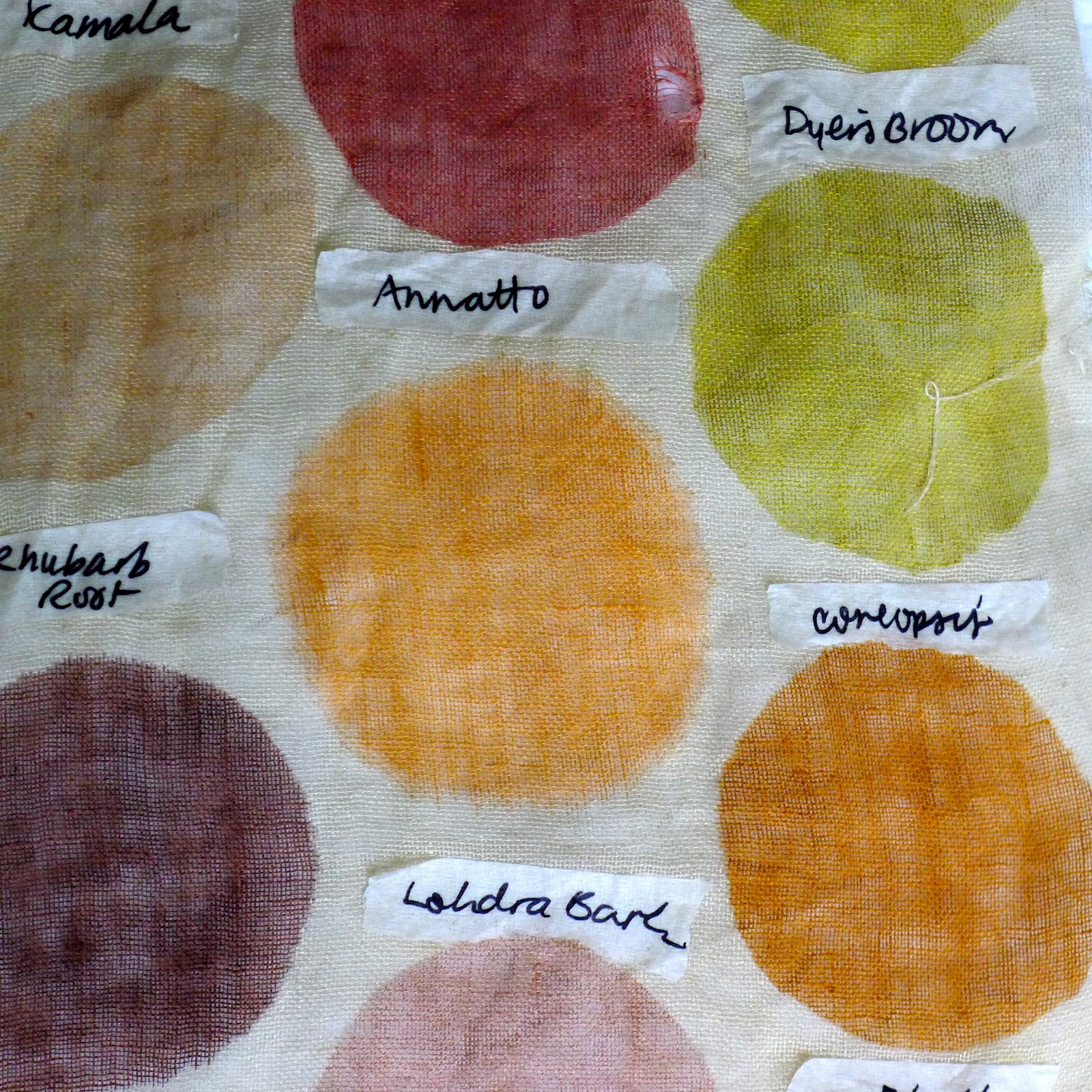
I thicken the extracts with a gum to produce a paste appropriate for screen printing. So far, as I'm only in the early stages of testing, I'm stencilling the print pastes onto mordanted cloth rather than screen printing, which will come later. The colour testing will also involve pushing the range of hues by shifting colours by adding acid, alkaline or other mordants to the colour after it has been applied. What you see here are some of my early samples in progress, which give you an idea of the range of colour you can achieve using all natural colourants, all derived from plant and a few insect sources.
A large part of my investigation is researching the plants that produce dyes, and their chemical, cultural and economic histories. I've been making ink and crayon drawings of these plants from historical herbaria (scrapbooks of preserved dried plant specimens) to develop imagery which I will later use in screen printed patterns.
When I return home, I hope to share my newly gained knowledge with anyone wanting to learn more about these precious and wonderful sources of colour. Read more about my project over the next 6 months as it progresses on my blog, now up and running again after months and months of neglect!
Labels:
Beehive Craft Collective,
Maiwa,
Natural Dyeing,
Textiles,
Thea Haines
Friday, 16 December 2011
Quilts! at the Art Gallery of Hamilton
Recently the Beehive was granted the exciting privilege of a private visit to the Art Gallery of Hamilton’s exhibition Quilts! A Gift from Carole and Howard Tanenbaum to the Textile Museum of Canada. As pretty much all of us are textile superfans, we gazed with reverence at the 17 quits on display, marveling at the textures, colours and skilled handwork at play in these Canadian, American and British works dating back to the 1830s.
Though many of their makers are unknown (and were certainly not releasing artist statements!) , the quilts in their distinctiveness inspired us to try to imagine the thought process involved in creating them. Pieced Quilt (1880) for example appears to have no rhyme or reason in the colour placement - the maker seemingly having worked their way through their scrap pile, moving on to one fabric as they ran out of the last. Randomness in this and other quilts through the interruption of pattern (or lack thereof) has very personal and charming effect. Equally charming are the backs of the quilts, which we attempted to sneak peeks at wherever we could and oohed and ahhed at the boro-like patchwork or sweetness of a simple cotton paisley.
Some quilts appear to have been made with a more distinct vision, or boast luxury fabrics such as brocades, printed silks, and patterned velvets. Pieced Quilt with Sawtooth Stars and Diamonds Pattern (1836) is a particularly stunning example of a quilt made with naturally dyed silk (prior to the invention of synthetic dyes 20 years later) and has maintained a rich colour palette of purples, maroons, greens and reds. The crazy quilts - irregular patchwork quilts joined through decorative embroidered borders - incorporate many different luxury fabrics as well pieces of cultural history such as Crazy Quilt in 30 Blocks (1885) which includes a ribbon showing the "Great Bridge - length 5989 feet" aka the Brooklyn Bridge which was completed in 1883.

As the quilts range from having been completed in the 1830s to the 1950s, there is some textile history to be learned in this exhibit as well. While earlier English quilts tended to start with a central medallion then finish with a distinctive border (much like an oriental carpet, as seen in Framed-medallion Quilt (1850)), by the second half of the 19th century, quilters began to structure them as a series of blocks arranged in a grid - making them easier to sew as smaller blocks could be made individually and joined later. This style of quilting is much more common today than the more labour intensive method of assembling the quilt from the centre outward. The topic of labour and time came up frequently amongst us Bees as we tried to imagine how many hours must have been invested and wondered how the makers found the time. In our current age of the instant the amount of time invested in the more complex quilts is almost unfathomable and something to be admired.
Though originally intentioned as functional pieces, the Tanenbaums (skilled art collectors) were clearly drawn to these quilts based on their aesthetic impact and artistry. In placing them on the gallery walls, we are asked to re-examine our relationship to these domestic objects that are so frequently lumped in with the curtains or the welcome mat - to consider them as works of art. These are not simply quilts, they are Quilts! 
Quilts! A Gift from Carole and Howard Tanenbaum to the Textile Museum of Canada
On view until January 15, 2012
Art Gallery of Hamilton
123 King Street West | Hamilton ON | L8P 4S8
T: 905-527-6610
E: info@artgalleryofhamilton.com
artgalleryofhamilton.com
Photos by Hollie
Wednesday, 23 November 2011
Knit Nights at the Brain: Make Do & Mend
Earlier this month, a number of us Bees had the pleasure of attending a special edition of Knit Nights @ the Brain: Make Do & Mend. The evening was lead by the multi-talented and master mender, Becky Johnson, who to our delight agreed to stop in on Knit Night to share her mad mending skills, just in time for the chilly season ahead of us.
Armed with tins full of darning yarn and materials, Becky shared two mending techniques used to tackle the most daunting holes: classical darning, and swiss darning.
Classical darning is a mending technique that's used to repair existing holes in knits. This method is done by using an embroidery needle and yarn (of a weight that's similar to the knit being repaired) to create a warp between the two strongest rows on either side of the hole. The next step is to weave yarn through the warp, creating strong woven material that patches the hole, as well as reinforces the stitches around the damaged area so that the knit ceases to unravel. While the concept is easy to grasp, the real trick lies in creating a patch that matches the same weight and tension as the knit material below; too tight and the knit may bunch; too loose and the knit may sag. A darning egg helps in this process by providing a nice flat surface to work on, but a lightbulb (or even beer bottle, as was the case that evening!) would also do the trick, DIY style.
Most of us Knit Nighters focused on classical darning for the evening, but those who finished their repairs graduated to swiss darning -- a method of mending that's used to reinforce weak spots in woollens, not holes. In basic terms, swiss darning (also called the duplicate stitch) is done by threading new yarn through the knit, following the path of the existing knit stitches. Doing this strengthens the knit, thus preventing impending holes.
Unfortunately I didn't nab any swiss darning action photos, but I highly recommend checking out Becky's blog for some fantastic examples of her swiss darning, and other mending projects. (Sidenote: this is why I refer to Becky as master mender -- look at those socks!) Also worth checking out is this duplicate stitch video - a straightforward visual tutorial on swiss darning.
It was a pretty cozy Wednesday night at The Brain, and it was so nice to spend the evening learning a new craft, with both familiar and new faces. A super special thank-you goes out to Ms. Becky Johnson, for teaching us how to fix all the little (or large!) holes in our woolly lives.
Wednesday, 10 August 2011
Vendor Spotlight: Sartoria!
Sara Tori of Sartoria knows what all we Canadian folks need to get us through the depths of our epic winters. Her long-johns, tank tops and undies are made with love from reclaimed materials of the highest quality to keep you cozy as you cycle down windy streets, bustle to and from subway stations or just lounge around your living-room on a cool fall evening. Merino and cashmere wool sweaters are taken apart and re-sewn into one of a kind cozy garments, perfectly fit for a wide variety of body sizes and heights with no sacrifices made of style in the name of keeping warm.
We are so happy to be showcasing Sartoria in the Summer Craft Fair so we asked asked Sara to send us a little bit about about herself. She had some lovely things to say about her upcoming collection and all the wonderful folks it's dedicated to:
"The 2011.2012 collection : Entangling with Hope
This collection pays homage to individuals in every land who knew and know that to nurture hope is to keep alive the richest aspects of being human. Sartoria salutes these people who, in the face of atrocity and oppression, hold and nurture hope, in themselves and in community.
This collection is dedicated to all of you who are entangling with hope. who are finding a way to keep your spirit alive in these turbulent times. Who are remembering that compassion runs incredibly deep in us and who are reclaiming our value from the mandates of the government and the corporations. These luxurious fibres gifted from our animal allies, these pieces are made for you."
Sara totes her sewing machine along with her to top craft fairs like the Distillery Art Market and One Of A Kind Show in toronto as well as the Circle Craft show in Vancuver B.C. (and of course this weekend at the Summer Craft Fair!) You can also find her on line in her Etsy shop.
While I hate to say that fall is now fast approaching, I cant wait to pick up a pair of these lovely undies to match the tank top I already own (and love!) I'm hoping to spend winter entangled in some blankets adding my Sartoria outfit to the layers of natural wool I rely on for surviving the cold.
Sara totes her sewing machine along with her to top craft fairs like the Distillery Art Market and One Of A Kind Show in toronto as well as the Circle Craft show in Vancuver B.C. (and of course this weekend at the Summer Craft Fair!) You can also find her on line in her Etsy shop.
While I hate to say that fall is now fast approaching, I cant wait to pick up a pair of these lovely undies to match the tank top I already own (and love!) I'm hoping to spend winter entangled in some blankets adding my Sartoria outfit to the layers of natural wool I rely on for surviving the cold.
Labels:
Beehive Craft Collective,
Sartoria,
Summer Craft Fair,
Textiles,
Toronto,
Vendor
Wednesday, 13 July 2011
Hip to be Square: Granny Square Blanket!
Way back in the winter our fellow bee Courtney was kind (and patient!) enough to teach a few of us how to crochet simple granny squares at The Brain's regular Knit Night. In general I tend to gravitate towards simple projects that I can pick up and put down easily or do while watching a movie; it makes me feel like I'm being productive! Granny squares were the perfect project to fill my idle hands and use up that ever growing yarn stash. Slowly but surely, one square at a time, you're bound to build up enough little squares to make an afghan without having to tote around a large and daunting project.
Jenna Rose used some gorgeous light airy colors for her granny squares (above).
I love natural colors of wool and using Canadian or hand spun yarns, so for my project I used up some hand spun Manos del Uruguay left over from an old project and purchased some Briggs and Little yarn while on christmas vacation in Nova Scotia. I love Briggs and Little because it's a Canadian company and is very inexpensive for pure Canadian wool, which they buy direct from the producer. It makes an ideal yarn for natural dyeing as well as for large projects like blankets.
I started by dyeing some of the wool with onion skins, one of the easiest and most rewarding natural dyes to work with. After saving up my onion skins until i had enough to fill a pot, I dyed two balls of natural white "Heritage" (2 ply) yarn from the Briggs and Little line. I boiled the onion skins 'til the water was full of their dark rust color, then I filtered them out and placed the water back on to boil. I dyed one skein first which soaked up the strong darker yellow right away - the ball in the back of the picture below. Then I dyed the second skein in the remaining water - this is called an exhaust bath. The water is not as potent with dye but this second round will produce a softer, often more beautiful, shade of yellow.
To go with the natural yellows, I picked up some Heritage yarns in shades of grey and started making the granny squares that Courtney had taught me. The stitch was surprisingly simple. Starting with a small circle made with a few chain stitches and then working outwards with little "shells" of three double-crochet stitches followed by a few chain stitches you eventually get a square. There are many great books and videos on making granny squares and tons of variations of patterns but I thought I'd stick to the simple square, mixing up my colors to make every square just a little bit different from the last. Soon enough (and thanks to a couple seasons of "Mad Men" that I definitely needed to catch up on...) I had a big pile of granny squares ready to be stitched together into a blanket.
As I made up the squares I added in some bright fun bits of left over wool in my stash to fill out the blanket and add some different colors!
Using the same basic pattern of three double crochet stitches I edged each square, and stitched them together by picking up the edge of the previous square as I went. When I was all done I edged the whole blanket with a gradation of grey to black yarns to frame the whole thing making the lighter grays and yellows pop in the middle of the blanket.
And just in time for summer weather, voila! the perfect picnic blanket for Bay Front Park!
I think I'll spend my whole summer right here.
photos by Jenna Rose and Anna Taylor
I love natural colors of wool and using Canadian or hand spun yarns, so for my project I used up some hand spun Manos del Uruguay left over from an old project and purchased some Briggs and Little yarn while on christmas vacation in Nova Scotia. I love Briggs and Little because it's a Canadian company and is very inexpensive for pure Canadian wool, which they buy direct from the producer. It makes an ideal yarn for natural dyeing as well as for large projects like blankets.
I started by dyeing some of the wool with onion skins, one of the easiest and most rewarding natural dyes to work with. After saving up my onion skins until i had enough to fill a pot, I dyed two balls of natural white "Heritage" (2 ply) yarn from the Briggs and Little line. I boiled the onion skins 'til the water was full of their dark rust color, then I filtered them out and placed the water back on to boil. I dyed one skein first which soaked up the strong darker yellow right away - the ball in the back of the picture below. Then I dyed the second skein in the remaining water - this is called an exhaust bath. The water is not as potent with dye but this second round will produce a softer, often more beautiful, shade of yellow.
To go with the natural yellows, I picked up some Heritage yarns in shades of grey and started making the granny squares that Courtney had taught me. The stitch was surprisingly simple. Starting with a small circle made with a few chain stitches and then working outwards with little "shells" of three double-crochet stitches followed by a few chain stitches you eventually get a square. There are many great books and videos on making granny squares and tons of variations of patterns but I thought I'd stick to the simple square, mixing up my colors to make every square just a little bit different from the last. Soon enough (and thanks to a couple seasons of "Mad Men" that I definitely needed to catch up on...) I had a big pile of granny squares ready to be stitched together into a blanket.
As I made up the squares I added in some bright fun bits of left over wool in my stash to fill out the blanket and add some different colors!
Using the same basic pattern of three double crochet stitches I edged each square, and stitched them together by picking up the edge of the previous square as I went. When I was all done I edged the whole blanket with a gradation of grey to black yarns to frame the whole thing making the lighter grays and yellows pop in the middle of the blanket.
And just in time for summer weather, voila! the perfect picnic blanket for Bay Front Park!
I think I'll spend my whole summer right here.
photos by Jenna Rose and Anna Taylor
Friday, 8 July 2011
Vendor Spotlight: Scout & Catalogue

Here's another spotlight on one of our craft fair vendors! We're so excited to have Scout & Catalogue in the Beehive fair this August. Breanna's collections (mostly scarves and pouches) are heavily influenced by the bohemian beach culture of Mexico. In her 'scavenger collection', Breanna upcycles thrift store finds into limited edition pieces. We're so excited to see Scout & Catalogue at the fair! Breanna was kind enough to answer a few questions about her work:
Meg Makins: Tell us about yourself.
Breanna: My name is Breanna and I run the small fashion accessories label, Scout & Catalogue. I grew up in Vancouver, lived for a bit in Mexico and am now residing in Toronto with my boyfriend and a cat called Mouse. While I currently spend most of my days sewing I started my professional career as a graphic designer working in ad agencies and more recently as a creative director at the fashion retailer Aritzia. Leaving my 9 to 5 was both liberating and terrifying and I currently spend my days longing for co-workers to chat with and relishing in escaping the endless meetings that took up so much of my time in the office.

M.M.: Where/when did you become acquainted with your craft?

M.M.: Where do you draw creative inspiration from?
Bre: I draw inspiration from all over the place and tuck it away for future collections. These days I've been liking hazy summer photos, neon accents, the markets of Istanbul and India and summer cocktails served in Mason jars. I've also been obsessed with house listings - mls.ca is my go-to site for future fantasy dreaming.

M.M.: Describe your perfect atmosphere for crafting.

M.M.: How do you get your work out in the world? Where else can one find it?

Photos via of Scout & Catalogue
Labels:
etsy,
Fabric,
scout and catalogue,
Textiles,
Toronto
Wednesday, 18 May 2011
Surfacing
This past weekend marked a highly anticipated event in the Beehive calendar. It was the opening of Surfacing: contemporary textile and craft objects at James Buttrum & Son gallery on James Street North. Comprised of the work from eleven graduating students of Sheridan College's Textile program, this show aimed to illustrate and encourage discussion on the topic of contemporary crafting; specifically in regards to textiles and fibres.
I had some downtime during my own art crawl preparations at White Elephant (which never happens) and I knew I wouldn't get the chance to check the show out later in the evening, so I stopped by Friday afternoon, camera in tow. As each of these artists studied under one of our very own Bees at Sheridan - Thea Haines - I knew that this show would not disappoint.
![]() |
![]() |
| Sabrina Parrish |
![]() |
| Katherine Cordero |
![]() |
![]() | |
| Katie Walker |
![]() |
![]() |
| Keiley Stewart |
![]() |
| Left: Rachel Morrison Right: Melodie Flook |
![]() |
| Barbara Romanovsky |
Being a part of a craft collective, I may be biased in thinking that this was one of the best shows I have seen in recent history as a part of the art crawl. I think that a lot of times people equate crafting or fibre art with folk art (which is not necessarily a bad thing) and Surfacing served to redefine that view, exemplifying that textiles can be exquisite and delicate and detailed and fantastic and fun all at the same time. Beautiful work, beautiful show. I can't wait to keep an eye on each of the artists involved in the show as they continue to grow and fine-tune their respective crafts.
Subscribe to:
Posts (Atom)