Showing posts with label Canning. Show all posts

Wednesday, 4 September 2013

Abundance!


Summer is a busy time for bees, and it's always a busy season for us Bees, too.  I always start the season with an ambitious list of things to accomplish, and in the end, have to concede I can only do about 1/4 of what I planned.

A good part of my summers are always spent trying to capture the fruitfulness of summer, hoping to keep up with the fruits and vegetables as they ripen in the garden and appear at the farmers' markets. Last year while I was away in London, I didn't do any gardening or canning, and I really missed it!  I made up for it perhaps too much this year, having made ten different kinds of jam, frozen and canned tonnes of fruit, and put by so many pickles, that my freezer is full and my store of empty jars is very depleted, and the season not finished yet.  I hope my near and dear ones look forward to holiday gifts of jam, relish and pickles, because I can't possibly consume it all alone!

I planted my own cucumbers this year because I love French cornichons, and wanted to try my hand at making my own.  This entailed picking tiny cucumbers (about 5 cm long) every other day, and storing them in the refrigerator crisper until there were enough to make one jar. I used fresh tarragon from my herb garden in these pickles, as well as in the pickled radishes I made.  Just trying to keep up with the cucumber plants, I made a ton of dills, piccalilli, and mustard pickle relish, just because I didn't want any to go to waste.  In the end I had to stop picking them because there is no way one lady can eat that many cucumber sandwiches!


By late August, the whole vegetable garden, including my patio herb garden, is totally out of control, and I feel a little overwhelmed! I prune the herbs and hang them to dry for later use in cooking, infusions and herbal tea.

 
To keep up with the tomatoes, I've resorted to not only canning, but also oven-drying or freezing all those I can't eat.  Oven-drying couldn't be easier.  Simply halve small tomatoes, such as plum, paste or cherry tomatoes, or slice larger tomatoes, such beefsteaks or heirlooms.  Place in a bowl,  drizzle lightly with oil and toss to coat. Spread in a single layer skin-side down over parchment lined baking sheets.  Sprinkle with salt and pepper, and any herb you desire (thyme, rosemary or basil are my favourites).  Place in a preheated 275 F oven, and leave for 1 1/2 to 6 (yes, six) hours, depending on the size and juiciness of the tomato, and desired dryness.  I like to leave them semi-plump (about 3 hours).  You can pack them in oil, but I prefer to freeze them on a tray and then place them, once frozen, into a freezer bag, to use in sauces and as pizza toppings in the winter for a taste of summer.


Thursday, 22 August 2013

Mustard Making!


We made mustard! This was something that had been on our to-do list for a while, and with sausage season just around the corner, we decided it was time to give it a try. How we usually do things in the Beehive is that we choose a recipe, make a list of ingredients, and then call dibs on whatever we have already in our homes. We had everything that was needed on hand except the actual mustard seeds, which were purchased from Dilly’s at the Farmers Market (the yellow seeds) and Nations (the black seeds).


We all sat around the table, passed around the ingredients, and put them into our little jars, each making one cup of each mustard. This whole process took…about 15 minutes. For some silly reason we thought this whole mustard-making-process was going to be intimidating and tricky, but it was literally just measuring ingredients into a jar…and that’s it! So we ordered some pizza, grabbed our crafts, and had an impromptu Beehive meeting.


Then we waited 3-4 days, blended our concoctions at home, and reported on our findings. A few people found the lavender mustard a bit acidic, which might be because we substituted the water for white wine (assuming everything is better with wine – maybe not?), but other than that, the mustards turned out just lovely. I blended the yellow mustard and it was perfect (so flavorful!) but I’ve left my lavender mustard unblended for a few weeks, just to see what happens with some more time.
Here are the recipes we used:
Know of any tried-and-true mustard recipes? Feel free to share them in the comments!

Tuesday, 21 August 2012

On Fermentation and Failure

I was really looking forward to writing this post. A post all about the time that I fermented a huge batch of delicious, full-sour pickles. I had it all planned out in my head - I would talk about how much I loved pickles, how I will never turn down a pickle, how I am that person that orders the deep fried pickles or the huge "Chilly Dilly" pickles on a stick from drive-in movie theatres or street festivals. I would touch upon how even though I have enjoyed my homemade vinegary canned pickles from the last two summers, they weren't the same as the sour dill pickles in cloudy brine that are my absolute favourite type of pickle. I would take beautiful, mouth-watering photographs of my finished product to show you, and try to inspire you to do this easy process at home yourself. It was going to be an all out pickle love-fest, and that's the kind of love-fest that I can fully get behind.


But my fermentation didn't work. Well, I mean, it did work. It only worked too well.

I did my research and most of my reading said that pickles should ferment in their saltwater brine solution for 2 1/2 to 3 weeks. I bought a bushel of small, young cucumbers, picked early that morning. I scrubbed all the cucumbers and removed the blossom ends with a sharp knife, as leaving it on can lead to rot. I used fresh dill, fresh Ontario garlic and a mixture of spices made up from mustard seed, coriander seed and whole peppercorns. I filled my 5 gallon fermenting crock with the correct proportions of water and coarse salt, and weighed everything down with a plate. On top of that, for extra weight, I placed a mason jar filled with water. I covered it all with a tea-towel and tied it with some twine. I sat back and waited for nature to do it's thing.

I was diligent and scraped the forming yeast off of the top of my crock each day, and tasted them every couple of days to see if they were ready yet. They gradually changed in colour from bright green to a faded olive and it seemed as if everything was going smoothly. The smell of dill filled our house. However, I had a vacation away from home coming up on the calendar, and as that neared closer, my pickles were still not quite there yet. I would be gone for week, a week that put the pickles from 2 weeks of fermentation to 3. I enlisted my sister who was house-sitting to be on scum-scraping duty and she was happy to help.

Upon returning from vacation,  I was ready to process and can the fermented pickles pretty much as soon as I walked in the door. But it was too late, I was gone too long. I inspected my batch and discovered that my pickles had turned to absolute mush on their insides while I was away. I had never anticipated that they would have spoiled so completely and so quickly within my estimated timeline. I tried one at the bottom of the batch that was not as gooey as the rest, and the flavour was incredible. A heart-breaking failure.


Not always succeeding is something we talk about within the Beehive often. I admittedly got pretty bummed out about having to discard my entire batch. I dramatically wailed to my husband in between tears "it's back to reality and it's all spoiled picklesssss!"

It's easy to become a defeatist and give up and think that every handmade or DIY project is not worth all the time, energy and effort when one that you put so much into turns out poorly. It's easy to not try at all when the possibility of failure is lurking just around the corner. Failing at something that you put your heart into is one of the worst feelings in the world, and can shatter everything you know to be true about yourself and your abilities in an instant.

But making mistakes is one of the best ways to really learn a lesson. All of the Bees try and lead lives where we make as much as we can by hand. It's one of the principles that brought us all together as a group. Making things by hand can often be tedious and requires patience, as it's not always about convenience. As many successes that we have with our DIY projects, we have just as many failures. After picking our self-confidence up off the floor, we take our new knowledge of our failure and try and turn it into inspiration to do a better job at it the next time around. Because when you do get it right, there's really nothing sweeter.

I recently took a dress-making class at Needlework where the wonderful instructor Mary confided in me that she was so surprised to see so many of the Bees signing up for her sewing classes. She had assumed that we were all proficient sewers.

We don't know everything. We make mistakes. The most important thing is that we try. Sometimes we have to try again. And hopefully, I'm not too late in the season to pick up another bushel of young cucumbers.

Wednesday, 31 August 2011

Canning Peaches


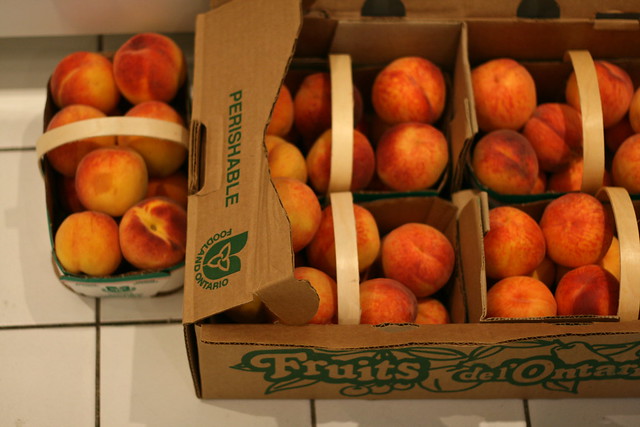
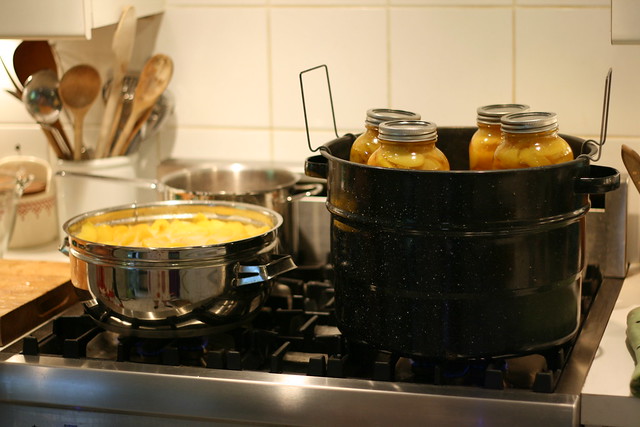
On Sunday a few of us got together at Thea's to can peaches! This wonderful fruit is at its best right now and we really wanted to capture its deliciousness and preserve it for future enjoyment.


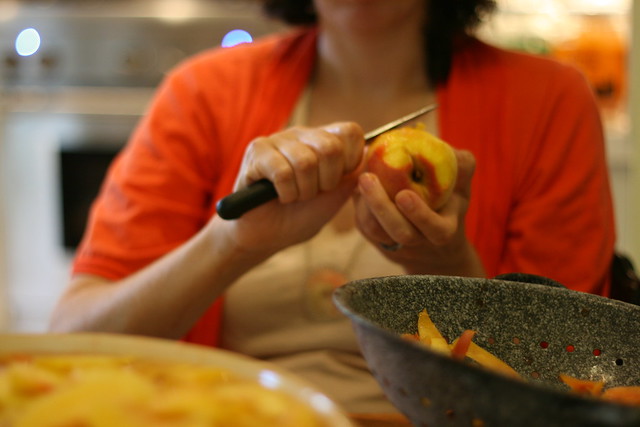
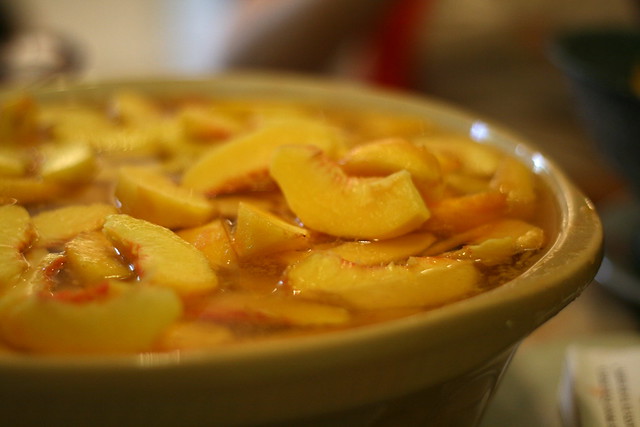
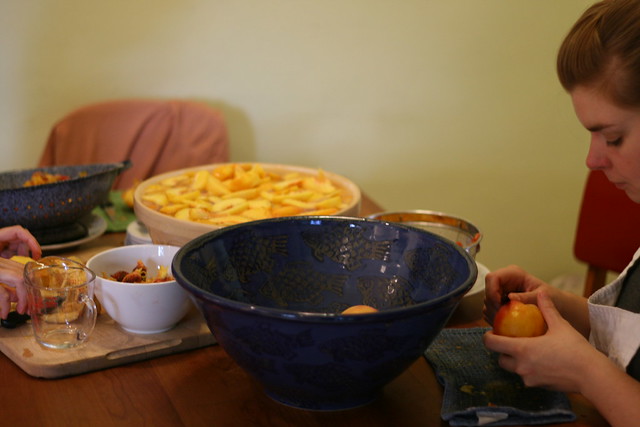
The most time consuming and messy part of canning peaches is the peeling and slicing bit. The more hands helping out, the better! In order to make the peaches easy to peel, we blanched them in boiling water for 30-50 seconds. Then we peeled them, sliced them, and put the slices in a bath of water with lemon juice in it. The lemon prevents the fruit from darkening unattractively.

It's best to can peaches that are just beginning to soften. If they're too soft, they may just fall apart when cooked. If they're too hard, they're a major pain in the derriere to peel.


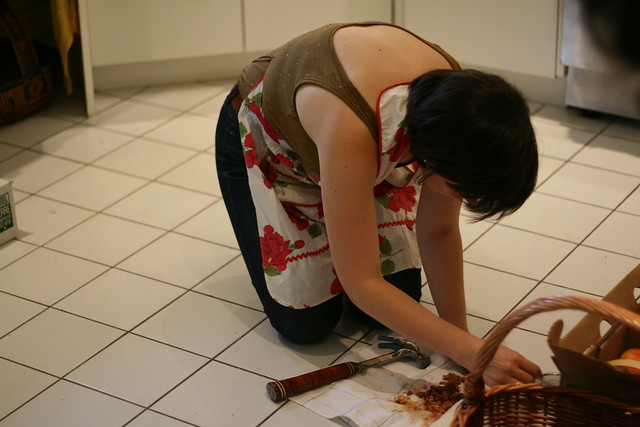
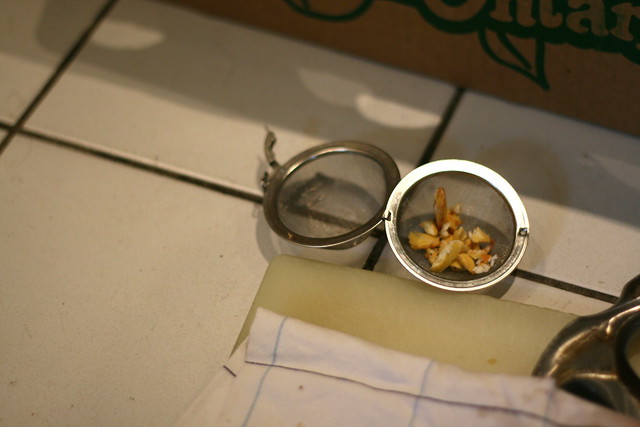
Thea informed us that peach pits contain pips that have an almondy scent and flavour (peaches and almonds are related after all). So she cracked a few pits open with a hammer, and put some pips in a tea infuser, which we placed in the syrup to give it a slight almond flavour. Yum!


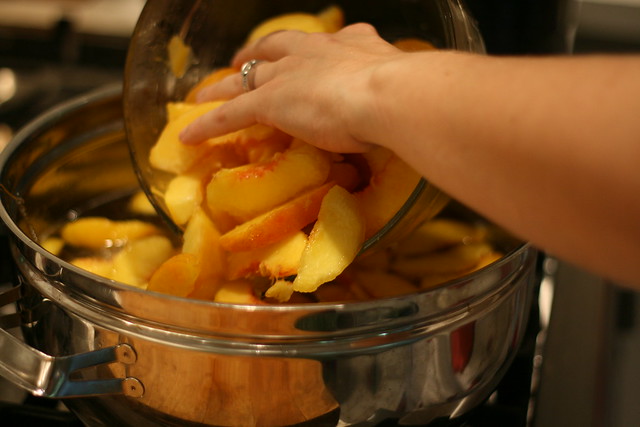
In batches, we added the sliced peaches to our sugar syrup mixture. We made a medium syrup, a combination of 6 cups of water with 3 cups of sugar. The peaches were cooked in the syrup for 5 minutes. This is the "hot pack" method of canning, since the fruit is heated before being canned. It's the most commonly used method for preserving fruit since it is a bit safer, and makes it easier to get the fruit in the jars. You can also "cold pack" or "raw pack" the fruit by putting it in without cooking it in the syrup, and then pouring the hot syrup on after.


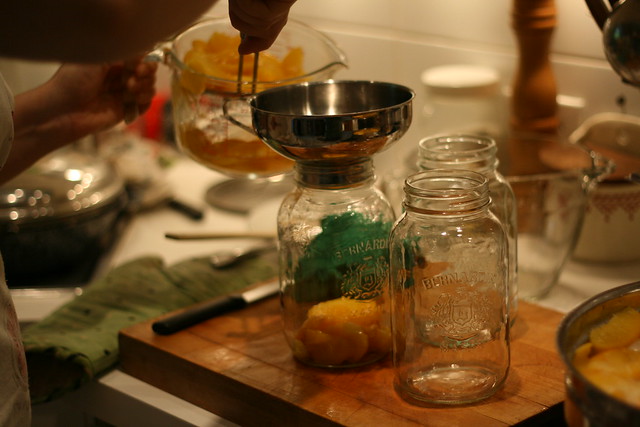
With a slotted spoon, we ladled the peaches into hot sterilized jars, then added the syrup until there was about 1'' headspace. Wide mouthed funnels are a canner's best friend.


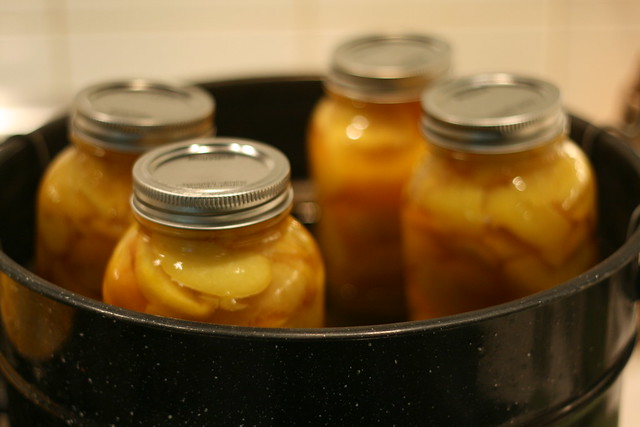
We processed the canned peaches in the canner for about 20 minutes.


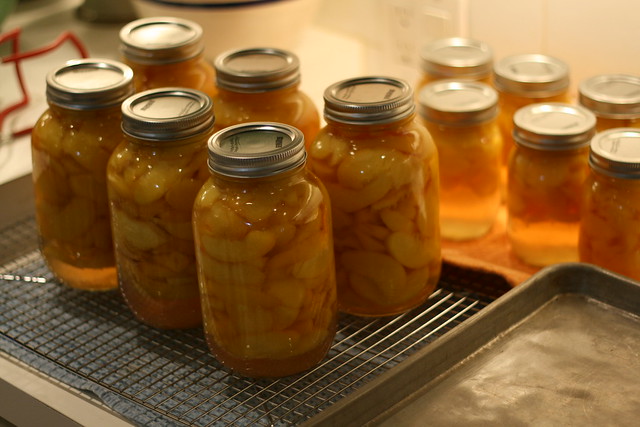
Et voila! Peaches galore! They will provide a wonderful taste of summer in the cold dark days of winter. Yum.

Tuesday, 5 April 2011

Our Roots, Part IV: The Farm

Two summers ago, a group of us were toying with the idea of starting a shared vegetable garden somewhere in the downtown area. That’s when our good pal Gary stepped in and offered up a much better suggestion: his parent’s farm had an acre of land that we could use, just outside of the city. That summer, The Farm was born.

The Farm belongs to the Buttrums, a family of farmers (and friends) who have been at the Hamilton Farmers’ Market for seven generations, since the 1880’s. Gary’s parents run the farm and sell their produce at the market. Squash, potatoes and tomatoes are their key crops, but they have grown all sorts of vegetables over the years. When they offered us up some of their land, we were beyond thrilled.

The first summer, we cleared the back acre of land up at the farm and planted our crops as quickly as we could. It was already late May by the time we started farming, so we didn’t have a lot of planning time. We started heading up a few days a week to plant seeds, move rocks, weed, weed some more, and finally, harvest. When the harvest came, it was bountiful. It was also a little crazy. Beans sprouted up faster that we could possibly pick them, and by the time the frost came, we probably had about 300 heads of cabbage that we needed to find homes for. Some of the excess went to the Hamilton Farmers’ Market, but even then we still had too much.

With the help of Gary and his parents, we’ve learned a lot about farming since that first summer, and we’re still learning. Last year more friends came up to the farm, and we expanded our farming area to cover the other five acres of farm land owned by the Buttrums. We helped farm their key market crops, and in return we got to use the remaining land for delicious tomatoes, beets, potatoes, hot peppers, onions, carrots, broccoli, cucumbers, zucchini and more.

It’s hard, but rewarding work. Most of the weeding takes place on your hands and knees, so you often leave the farm a little worse for wear. Still, when the weather is nice, or the sun starts setting, I can’t think of a better place to be. It’s so satisfying to grown your own food and know exactly where it came from, and what (if anything) went into it. It’s a rewarding experience to get back to the basics, and become part of something so sustainable.

We don’t use any chemicals at the farm, and even though we prefer it that way, sometimes the crops suffer as a result. Last year these pesky Colorado Potato Beetles pretty much wiped out our supply of potatoes, and most of the tomatoes suffered from a blight. It’s a small price to pay for knowing we are eating natural, pesticide-free food.

Last summer we grew a little of everything you could possibly think of, and we did our very best to minimize any waste. We planted in phases so that not all the crops were ready at once, and we had a steady system of weeding and harvesting going on all summer. We hosted canning parties, made lots of soups and stews, and organized an outdoor market outside of White Elephant during the art crawls. Everyone from the farm volunteered to help harvest & transport the vegetables, and set up the stand outside of the shop. Hollie’s sister Nikki was often the face of the market stand, and she did an amazing job.

This summer we are seriously stepping up with the farm. We have a ton of new friends who are interested in coming up, and we are taking this job seriously. Gary has appointed Hollie as Farm Manager, so we have someone to help organize and keep us all on track. We’re growing new crops, and bringing in something we are all really excited about: BEES. Some new friends are bringing their 3rd generation beekeeper experience to the farm this summer, and we’ll have our very first hives.

We’re also planning to plant a natural dye garden, full of Madder, Indigo, Goldenrod, Hollyhock and more. There’s going to be a 6 x 20 foot natural dye garden, so you can expect lots of Beehive dyeing projects in the future. The weather is just starting to warm up here in Hamilton, and farming has been on everyone’s minds. I can’t wait to get back out there and get started on all the new ideas and projects we have planned, and I’m sure you’ll hear a lot about it this summer on the Beehive blog. Photos courtesy of Jane, Hollie and Gary Buttrum

Monday, 28 February 2011

Our Roots, Part I: Summer Pickle Bees


To help you become better acquainted with the Beehive Craft Collective, over the next few weeks we will be telling you our story - starting with some of the common interests and activities that first drew us together. Many of us Bees share an interest in food - eating, cooking, baking, and waxing poetic over it. This includes finding enjoyment in growing the food ourselves. Some of us, like me, were born in the vegetable patch, and grew up close to our food. For others, local food has become an important part of our lives, and who can imagine a source nearer than the bean you pick with your own hands? For the last couple of years, through the generosity our friend Gary Buttrum and his family, some of us have been lucky enough to have the chance to grown our own. You will no doubt hear more about the farm as you get to know us, but to read more about it, please see Hollie and Jane's reports of farming adventures. This last summer, we found ourselves with an over-abundance of beans, cucumbers and zucchini. There is something quite satisfying in rising from picking row upon row of beans with a full bushel basket of waxy yellow beauties. Yet, after the end of the picking session finds you with more beans than can be eaten fresh and taken to market, what to do?


Why, have a pickling party, of course! Many hands make light work. Many of us pickle and preserve on our own, but we had so many vegetables, and also wanted to share the pickling bounty with our non-pickling farm friends. So Hollie and I gathered together a group of like-minded ladies, and last year we had two pickling parties, which we have come to call Pickle Bees. A working 'Bee' is a gathering of peers to accomplish a task, making social and enjoyable what otherwise might be a tedious chore. I think this is the perfect description of our bees.


The Pickle Bees were also an easy way to try an untested recipe. We'd never tried making dilled beans or relish, and ending up with one or two jars of a new pickle is much better than been stuck with six jars of an unloved preserve. In the end, all the recipes turned out great, and were delicious. Together we ended up with dozens of jars of dill pickles, dill beans and zucchini relish. We shared the jars amongst the the Pickle Bee attendees, and gave the remaining jars to our farming friends.


This year I look forward to a spring and summer of planting, weeding (that's a lie, as I detest weeding), harvesting, and marketing, but what I most relish is the cooking, pickling, preserving, jamming and baking, and the eating, of course. It will be an even more delicious season in the company of wonderful friends.  

Photos courtesy of Jesse Senko, Hollie and Kate