Showing posts with label Natural Dyeing. Show all posts

Wednesday, 7 August 2013

A Crafty Long Weekend: Natural Tie-Dyeing at the Cottage


This long weekend I took advantage of some time off and good weather to head up to my family's cottage on Lake Simcoe. I've found that the distractions and responsibilities of everyday life disappear while I'm up there, so it's an ideal place to work on crafty projects. This weekend I decided to focus on natural dyeing!


I've done some natural dyeing before, but had yet to venture into tie dyeing in this medium. When people think of tie dye, they often associate it with psychedelic bright neon colours and the hippy dippy fashions of the 1960s/70s. A few weeks ago I picked up Tie Dye: Dye it, Wear it, Share it, a book by fashion designer Shabd Simon-Alexander. This book is totally inspiring, and shows you how to use tie dye in more modern, wearable ways. I was confident that the soft, often muted colours of natural dyes would result in some lovely creations.


Hollie and Meg joined me on Sunday and Monday, but before they came up I got started on preparing some fabric to be dyed. To create polkadots I wrapped corn kernels (the only small uniformly round thing I had on hand) with fabric, then covered that with saran wrap, then elasticated it in place. I quickly ran out of elastic bands, so I scrunched the rest of the fabric and secured it with elastics.


The wonderful thing about tie-dye is that you can't go wrong! Sure there were some techniques we loved more than others, but everything we did looked great! It was all about experimentation. Some of our favourite techniques were folding and rolling (which creates stripes), and scrunching. "You can't go wrong with scrunching!" was an oft-heard phrase repeated throughout the weekend.


The best thing about natural dyeing at the cottage is being able to rinse everything out in the lake. Easy peasy! 


Peggy was present to inspect (and lick) our handiwork.


We rigged up all sorts of devices to try to get the dye patterns that we wanted. In the case of the above and below photos, Hollie wanted to only dip half of her bundle in the logwood dye bath, so she used a stick and some string to suspend it in place. 


We dyed with logwood (purple), madder (pink) and pomegranate (brown-ish). Using hot plates makes it possible to do this outside, which is great in the summer when the kitchen can be sweltering. It would be amazing to dye over an open fire one day.


Peg is an excellent supervisor.


We had a wonderful productive weekend, and now have lots of beautiful fabric to turn into napkins, scarves, blankets, tanks, and tees. 

Monday, 23 April 2012

A Dispatch from Calgary


Teaching in a specialized field like screenprinting and surface design gives me an opportunity to travel for work. I'm a most-of-the-time Hamilton resident, and some-of-the-time Calgary resident, spending the winter term at the very wonderful Alberta College of Art.


One of the classes that I teach there is the Fibre 101 class, which focuses on 2D work. I've been wanting to add a natural dye project into the class, particularly one that can be done outside of school, requiring no specialized equipment. So much of what I teach relies on specific, often expensive tools such as exposure units and vertical fabric steamers, and I remember coming out of school totally unsure of how to do things on my own.


The class was given the task of purchasing a silk scarf, eating pasta or pickles for a week to obtain a 1L-ish glass canning jar, and collecting natural materials that they thought might provide colour. I wasn't very specific with the materials, just asking them to gather what they could find from nature or from the kitchen. This was, of course, the week it was minus thirty-five outside, so most of the materials were from the kitchen.


After being laid out, the silk scarves were folded over to fit into the jar, and then rolled around a stick that the students also had to find. Then they are tightly bound with twine, and tucked into their jars. Some students opted to add a colour modifier in the form of giant rusty bolts [iron], old pennies [copper], or in one case, a huge, beautiful copper mineral deposit that the student bought from a gem and mineral show. We then filled the jars with a 10% alum solution, as alum is a good colour-brightening mordant that helps to stick the colour to the fabric, and usually brightens colours as well. oh, and all that drawing you see happening? that is each person making a 'map' of where they put what, so they could have a reference for what material made what colour when we were done. I'm big on note taking.


The jars are then placed in a sunny window to let the heat of the sun cook the fibres and their contents, as in the first image. A week later, we unpacked the jars, shook them out over a bin, and then rinsed the scarves. I learned a great lesson from my class in this assignment - use lots of herbal teas! They make the unpacking process actually nice smelling [my test run was really, really gross! make sure the bundle is submerged in the jar, or you get mold. Lots of it], and hibiscus and rose petals provide lovely colour.

Wednesday, 4 April 2012

Historical Interpretation


Today, a sneak preview of one of the activities lately occupying much of my time.  Last year I was asked to be a part of an exhibition this spring at Harbourfront Centre on the occasion of the bicentennial of the War of 1812.  The premise of the exhibition fits perfectly with the current vein of my work as I've been recently exploring through the lens of natural dyes how our deeper past can shape the future.  I've always been fascinated by my own family's history, which is rooted in its immigration to Canada between 200 and 400 years ago.  The War of 1812 in particular is an important part in that story, as several of my ancestors can trace their settlement in southern Ontario to the period following the war.


I've been pondering the blurred lines between historical fact and fiction, how in the present we interpret the past, romanticize and embellish it; it is these narratives that bring the past alive.  With that in mind I decided to construct a costume for an especially legendary figure of the War of 1812, Laura Secord. The pieces I've been working on are based on garment patterns intended for historical interpretation and reenactment from Sense & Sensibility patterns.  In the process of sewing every stitch by hand of these regency era garments, I've learned just how laborious clothes-making was before the sewing machine.  No wonder clothing had so much more value historically.  I realised also that while the regency period was a period of relative freedom in women's dress, women still had to contend with layers of petticoats and undergarments that restricted their activities.


I've spent much time constructing undergarments, and now I've moved on to the outerwear, a dress and red coat. The piece above, the dress, has been printed with iron paste in imagery of plants of the roadsides of southern Ontario - purple loosestrife, goldenrod and Queen Anne's Lace. The rust colour will change once I've dyed the dress in a bath of oak gall, to the colour you see below.


1812-2012:  A Contemporary Perspective opens Friday April 20th, with a public reception beginning at 6 pm, at Harbourfront Centre, 235 Queen's Quay West, Toronto. 

Tuesday, 7 February 2012

A Bee Abroad


In October, I temporarily left the hive to move to London, England, while I study for my master's degree in textiles at Chelsea College of Art & Design. I chose Chelsea because its Textile program has a focus on sustainability, which is becoming an increasingly important aspect of my work, and outlook on life. Chelsea has an unique research centre, TED (Textiles Environment Design) which is part of a larger partnership with Central Saint Martin's called the Textile Futures Research Centre. For anyone interested in textiles in general and sustainability specifically, explore both their websites for volumes of fascinating research and inspiring projects.


My MA project focuses on natural dye printing, something with which I've long wanted to experiment. So much of my own work and teaching involves screenprinting, and as much as I love the beautiful effect of printing with conventional fibre-reactive or acid dyes, I worry about the long term health and environmental effects of all the chemicals involved in the process. I've had a lot of experience using natural dyes for immersion dyeing, some of which we've shared with you here on the Beehive, but little experience with using natural dyes for printing. I had a sense of how they might work for printing, but I'd never really tried to use them.

I thought the perfect way to begin would be to take a workshop at the Maiwa Symposium in Vancouver, which is also something I've always longed to do but could never fit in, as the symposium falls during the fall school term. The workshop at Maiwa gave me the confidence to get going!


Since arriving in London and settling into the studio at Chelsea, I've been experimenting with the colours I can produce using the various natural dye extracts available from different sources. Maiwa, Couleurs des Plantes, Couleur Garance, Earthues and Pure Tinctoria all sell a variety of ready-to-use natural dye extracts from ethical and sustainable sources. The extracts are relatively easy to use as they dissolve in water, but you can also make your own extracts from dried or fresh dyestuffs.

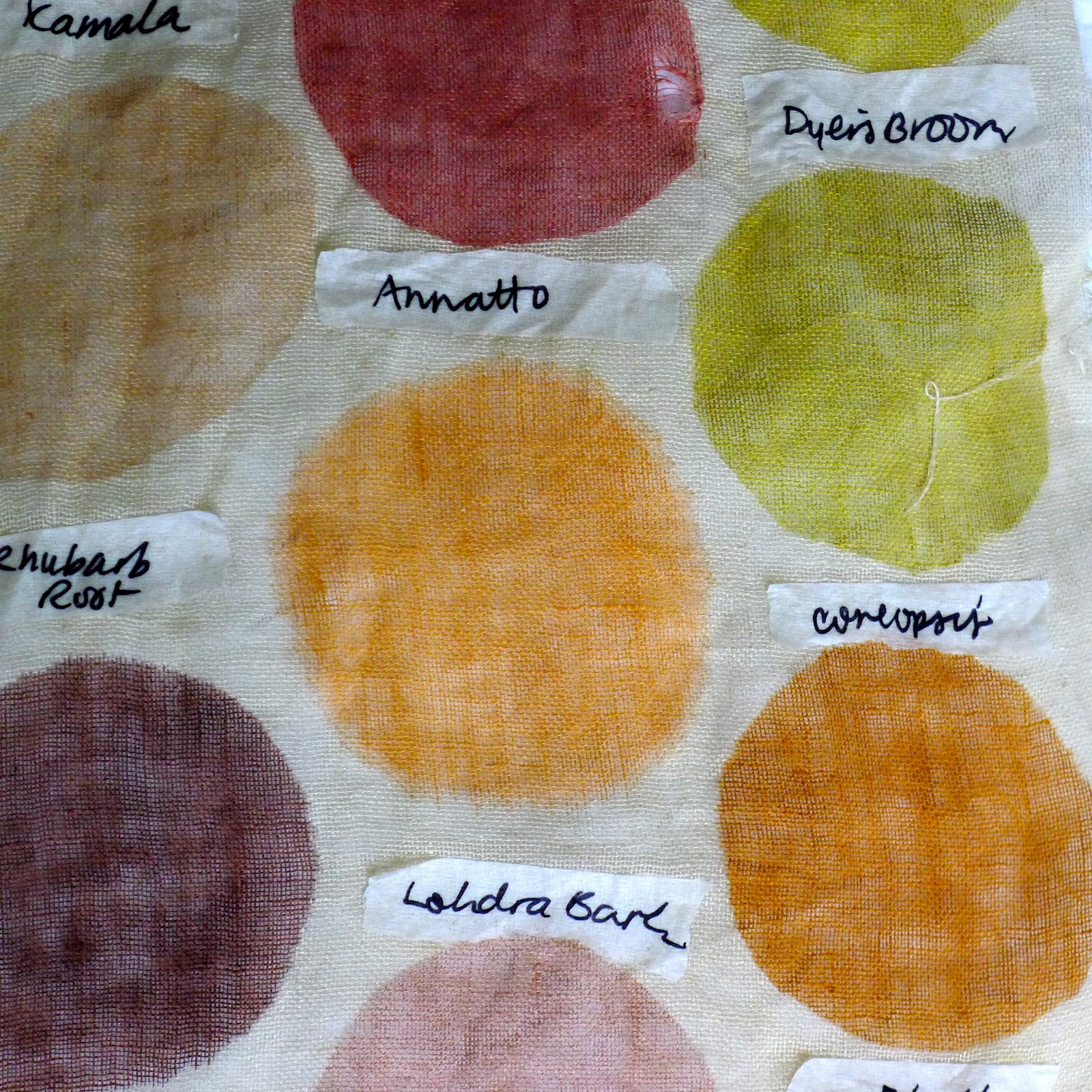
I thicken the extracts with a gum to produce a paste appropriate for screen printing. So far, as I'm only in the early stages of testing, I'm stencilling the print pastes onto mordanted cloth rather than screen printing, which will come later. The colour testing will also involve pushing the range of hues by shifting colours by adding acid, alkaline or other mordants to the colour after it has been applied. What you see here are some of my early samples in progress, which give you an idea of the range of colour you can achieve using all natural colourants, all derived from plant and a few insect sources.


A large part of my investigation is researching the plants that produce dyes, and their chemical, cultural and economic histories. I've been making ink and crayon drawings of these plants from historical herbaria (scrapbooks of preserved dried plant specimens) to develop imagery which I will later use in screen printed patterns.

When I return home, I hope to share my newly gained knowledge with anyone wanting to learn more about these precious and wonderful sources of colour. Read more about my project over the next 6 months as it progresses on my blog, now up and running again after months and months of neglect!